
7 Beginner-Friendly Work from Home Laptop Jobs to Apply For
Work from home laptop jobs are real, and you can start several of them without a degree. The best beginner picks are customer service, data entry, virtual assistant work, online tutoring, AI training,...

Work from home laptop jobs are real, and you can start several of them without a degree. The best beginner picks are customer service, data entry, virtual assistant work, online tutoring, AI training, content writing and remote IT support. Choose customer service or data entry if you want hourly pay and possibly company equipment. Choose tutoring or AI training if you have a language or subject skill. Choose virtual assistant or writing work if you prefer freelancing. So yes, you can work from home with just a laptop, as long as you also have reliable internet and a quiet place to work.
The hard part is not finding listings. Job boards show thousands of "remote" postings, and many are commission-only sales roles, hybrid jobs or scams hiding behind "no experience needed." You need to know which jobs truly run on a laptop, what they pay and who supplies the equipment.
Each job below follows the same format: what the work involves, pay and equipment, and who it suits with first steps. Pay figures are typical ranges from postings on major job boards. Treat them as a guide and confirm the numbers in the posting itself.
1. Customer service representative
Customer service is the most common entry point for work from home laptop jobs, because the work is easy to train and easy to do remotely.
What the work involves
Reps answer customer questions by phone, chat or email using the company's software. Remote openings cluster in healthcare, insurance, e-commerce and logistics, so you can pick an industry you understand.
- Resolve billing, order and account problems
- Log every contact in a ticketing or CRM system
- Follow scripts and escalate hard cases to a supervisor
Pay and equipment
Entry-level remote customer service postings commonly list $16 to $25 an hour, and bilingual roles can climb into the low $30s. At $20 an hour for 40 hours, you earn $800 a week before taxes.
Equipment varies. Some employers ship a laptop, monitor and headset, while others require your own laptop and reject Chromebooks. Healthcare postings often require a private, noise-free, HIPAA-compliant space at home. Large employers such as Amazon and Verizon have listed remote customer service roles and have supplied computers and headsets, though availability changes.
Confirm in writing who supplies the laptop, headset and software before you accept any offer.
Who it suits and how to start
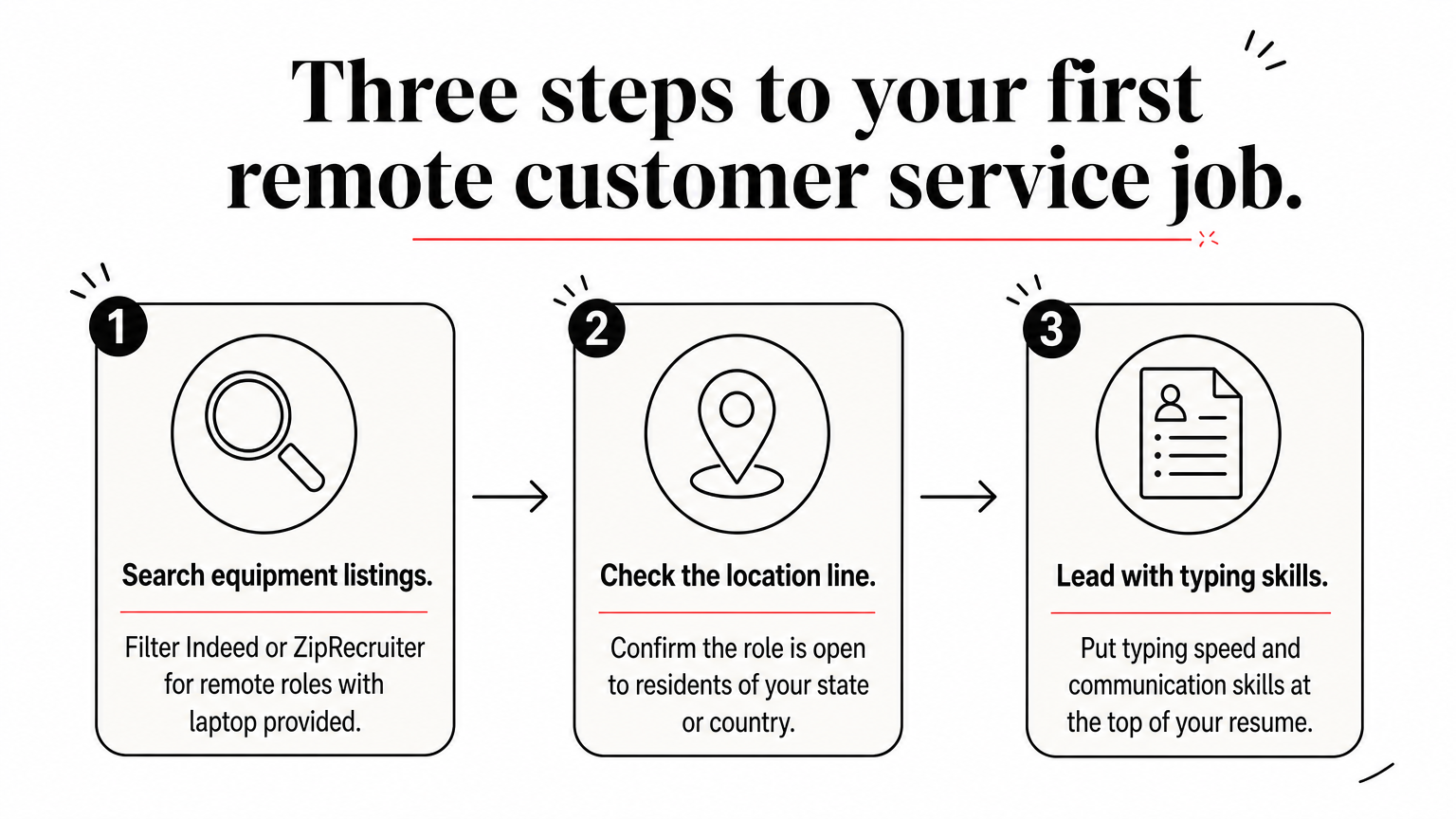
This job suits patient people who write and speak clearly and can follow a process. Start with these steps:
- Search "laptop provided" or "equipment provided" on Indeed, ZipRecruiter or SimplyHired and filter for remote.
- Read each posting's location line. Many remote jobs are limited to US residents or specific states.
- Put typing speed and communication skills at the top of your resume.
2. Data entry clerk
Data entry is the classic laptop job: you need accuracy and a quiet hour, not special training.
What the work involves
Clerks move information from one place into another. Employers in administration, healthcare and finance hire for it, and some listings are full remote while others mix in office days.
- Type records into databases and verify the figures
- Update spreadsheets and customer lists
- Flag duplicates and errors for review
Pay and equipment
Pay swings widely by industry, so compare the posted hourly rate with customer service roles before you apply. Most data entry employers expect you to use your own laptop. Some add a VPN or company software for security.
Be strict about one rule. Never pay for training, software or equipment, and ignore any employer who mails you a check to buy a laptop. Both are classic scam patterns.
A real data entry employer pays you, and it never asks you to pay for the job.
Who it suits and how to start
This job suits detail-oriented people who like quiet, repetitive work. A high school diploma is a common requirement. Take a free online typing test, then learn basic spreadsheet functions such as SUM and VLOOKUP in Excel or Google Sheets. Apply first to administrative openings at healthcare and finance companies, where this work is steady.
3. Virtual assistant
A virtual assistant handles a busy client's small tasks from a laptop, and it works well as one of the work from home jobs with a laptop that you can start freelance.
What the work involves
Clients are usually small business owners, coaches or consultants who are short on time. You take over the tasks that eat their day.
- Manage inboxes and calendars
- Book travel and appointments
- Prepare simple reports and update social media
Pay and equipment
Freelance assistants set their own rates, so pay depends on your skills, your niche and how many clients you land. Specialized help such as bookkeeping or podcast support usually earns more than general admin. You supply your own laptop, headset and tools, and many clients expect you to learn Google Workspace, Slack and Zoom.
Narrow niches earn more, so start general to get clients, then specialize in what you do best.
Who it suits and how to start
This job suits organized people who can work without supervision. Pick three services you can deliver well, make a simple one-page sample of your work, and pitch five small businesses you already know. A few paid test tasks will give you reviews and confidence faster than waiting for a perfect portfolio.
4. Online tutor or English teacher
Tutoring pays by the hour and needs only a laptop, a headset and a stable connection, which makes it a strong pick if you know a subject well.

What the work involves
You teach reading, math, test prep or conversational English over video. Some companies assign students, while others let you set a schedule on a booking platform.
- Prepare short lessons or follow a ready curriculum
- Teach over video and give feedback
- Log session notes for parents or the platform
Pay and equipment
Evening tutoring postings have listed roughly $18 to $22.50 an hour, and online English teaching postings about $15 to $24 an hour. Platforms typically ask for a laptop or desktop with a current browser, reliable high-speed internet and often a webcam. They rarely supply equipment.
Because demand peaks outside school hours, expect evening and weekend shifts. Many platforms ask for a degree or a teaching certificate such as TEFL, so read the requirements first.
Check whether the platform assigns students or leaves you to find them, because that decides how many paid hours you get.
Who it suits and how to start
This job suits patient communicators, bilingual speakers and students who are strong in one subject. Test your camera and connection, record a two-minute sample lesson, and apply to platforms whose posted time zones match your evenings.
5. AI training and data annotation
AI training means checking and improving the answers of AI systems, and it is one of the few laptop jobs where deep subject knowledge directly raises your pay.
What the work involves
Contractors rate AI responses for accuracy and quality, correct mistakes and write feedback. Projects range from simple labeling to coding, research or writing tasks.
- Compare two AI answers and explain which is better
- Fact-check outputs in your area of knowledge
- Rewrite weak responses and follow detailed guidelines
Pay and equipment
Annotation postings have listed about $16 to $28 an hour, while specialist projects have listed $25 to $70 an hour, with 15 to 40 hours a week. Work is project-based and usually contract, so hours can stop when a project ends.
You use your own laptop. Most companies require an application, a profile and assessments or interviews before you see any projects. Passing an assessment does not guarantee steady work.
Treat AI training as flexible contract income, not a guaranteed full-time paycheck.
Who it suits and how to start
This job suits careful readers and people with expertise in coding, writing, finance or another field. Create profiles on a few platforms, pass the assessments honestly and never pay a fee to get "access" to projects.
6. Freelance content writer
Content writing needs only a laptop and a word processor, and it rewards practice more than credentials.

What the work involves
Clients pay for blog posts, product descriptions, emails and website copy. Editing and proofreading are related entry points if you prefer fixing text to drafting it.
- Research a topic and outline the piece
- Write to a brief and a deadline
- Revise after client feedback
Pay and equipment
Writers are usually paid per article or per word, and rates rise as you build samples and a track record. Beginners often start low, so aim to move to higher-paying clients after a handful of published pieces. You supply your own laptop and tools, so the main costs are your time and a reliable connection.
Samples sell writing services better than a resume does, so publish two or three pieces before you pitch.
Who it suits and how to start
This job suits people who enjoy research and can meet deadlines. Write two or three samples on topics you know, host them on a free blog or document link, and pitch small businesses and niche websites. Read every brief carefully, because late or off-topic work ends client relationships quickly.
7. Remote IT help desk support
Help desk work is the most technical item here, and it often comes with employer-supplied equipment because companies must control the security of their systems.
What the work involves
You help coworkers or customers fix everyday tech problems by chat, phone or remote desktop.
- Reset passwords and set up accounts
- Troubleshoot software, Wi-Fi and printer issues
- Track each problem in a ticketing system
Pay and equipment
Help desk roles usually pay more than basic customer service because of the technical skills, though the gap depends on the employer. Many remote employers issue a company laptop and require you to use their security tools. Postings often mention certifications such as CompTIA A+, along with familiarity with remote desktop tools.
Remote-first companies like GitLab and Zapier have offered laptops and home office allowances, but they tend to hire people with experience.
A short certification can move you from general customer service into better-paid, equipment-provided support work.
Who it suits and how to start
This job suits people who enjoy solving problems and explaining fixes in plain language. Study for CompTIA A+, practice with free remote desktop tools on a family member's computer, and apply for entry-level help desk or tier 1 support roles.
Choosing your first laptop job
The seven jobs above all run on a laptop, and each fits a different strength. Customer service and data entry are the quickest to enter. Tutoring and AI training reward subject knowledge. Virtual assistant and writing work need samples more than credentials. IT help desk work takes a little study but often comes with a company laptop.
Pick one job that matches a skill you already have, apply to five postings, and check the location line, equipment and pay before you reply. If any employer asks for money, walk away. For more practical earning ideas and beginner tech guides, browse the latest guides on Trick and Tech.


