
How to Earn Money Online: 10 Legit Ways for Beginners
The best answer to how to earn money online is to pick a method that pays you for work you can already do, with no fee to join and a clear payout. If you write, design or translate, start with freelan...

The best answer to how to earn money online is to pick a method that pays you for work you can already do, with no fee to join and a clear payout. If you write, design or translate, start with freelancing. If you are strong in a school subject, tutoring pays the most per hour of any beginner option. If you have free evenings and no special skills, paid user testing and microtasks let you start this week. If you own things you no longer use, reselling gives you the fastest first dollar.
The problem is that most advice promises $300 a day and delivers a sign-up form. Side hustle surveys put the average U.S. side hustler at about $530 a month, with a median closer to $200. That is real money, but it is a supplement, not a salary. You need honest numbers to choose well.
This guide covers 10 legitimate ways to make money online. Each one explains how it works, where to start, what it pays and who it suits. After the list, you get a side-by-side pay table, a realistic first-week plan, and the scam red flags to know before you share any personal details.
1. Freelance writing, design and translation
Freelancing is the best starting point if you already have a skill, because you sell a finished piece of work instead of your spare minutes. Beginners with a skill can build the highest income on this list.

How it works and where to start
You deliver a finished job, such as an article, a logo or a translated document, and you invoice for it. You need a profile, two or three samples and the habit of pitching every day. Profile quality matters more than the platform when you are new, so build the samples first. Upwork, Fiverr and Freelancer.com are the main marketplaces where clients post jobs.
Pick one lane to begin with:
- Writing: blog posts, product descriptions, newsletters and email copy.
- Design: social media graphics, logos and templates. Canva lets you start without expensive software.
- Translation: documents and web content, if you are fluent in two languages.
What it pays and who it suits
Writers earn roughly $0.05 to $1 or more per word. Designers on Upwork commonly charge $40 to $75 per hour. Translation pays about $0.10 to $0.30 per word. New freelancers sit at the bottom of these ranges. A 1,000-word article at $0.10 per word pays $100, so five of them a month is $500.
This suits anyone with a skill and the nerve to pitch. If you pitch daily, your first payment can arrive within days, though a few weeks is more realistic. Many beginners reach $500 to $2,000 or more per month after 6 to 12 months, once clients start coming back.
Freelancing has the highest ceiling here because you sell a skill, not your free time.
2. Virtual assistant and remote customer support
Virtual assistant work pays steady hourly money for being organized and reliable. It suits people who do not want to build a portfolio first.
How it works and where to start
Small business owners hand off email, scheduling, data entry, bookkeeping prep and chat support. You work set hours or a set number of tasks each week. You can find this work through listings on Upwork and Fiverr, or by contacting small businesses and offering a trial week. Some companies, such as Belay, hire remote assistants directly. Remote customer service roles are also posted on general job boards.
Before you apply, prepare:
- A short list of tasks you can do well, such as inbox cleanup or calendar management.
- A quiet space, a reliable internet connection and a headset.
- Two references or a sample of your work, such as a clean spreadsheet or a template.
What it pays and who it suits
Virtual assistants typically earn $15 to $50 per hour, depending on the tasks. Remote customer service pays about $15 to $25 per hour. At 10 hours a week and $20 per hour, you earn $200 a week, or about $800 over four weeks.
It suits organized people who communicate clearly and meet deadlines. Employers care more about reliability than about a degree. Ask whether a role is contract work or employment, because contractors handle their own taxes.
Clients pay for reliability, so answer fast and deliver on time, and you will rarely run out of work.
3. Online tutoring and teaching English
Tutoring pays the best hourly rate of the beginner options that need no portfolio. If you know a subject well, someone will pay for your time.
How it works and where to start
Students book video sessions through a platform, and you teach from home. Wyzant, Tutor.com and Chegg Tutors connect tutors with students in school and college subjects. Cambly, Preply and italki match English speakers with learners abroad. Outschool and Skillshare are options if you can teach a specific skill, such as Excel, photography or fitness.
Platforms keep a cut of each session, so check the fee before you set your rate. Some also ask for credentials or a short test, and many require you to be 18 or older.
What it pays and who it suits
Subject tutoring typically pays $20 to $60 per hour. Teaching English online pays about $10 to $25 per hour. A tutor charging $25 per hour who works three hours a week earns about $300 in four weeks.
It suits people strong in math, science, test prep or conversational English, and anyone comfortable on camera. Evenings and weekends are the busiest hours. Your first few weeks may be slow while you collect reviews, so price a little lower at the start and raise your rate as bookings fill.
Tutoring rewards expertise you already have, so choose the subject you know best, not the one that pays most.
4. Paid user testing
Paid user testing is one of the easiest ways to earn your first $100. Companies pay you to use their website or app and say what you think out loud.
How it works and where to start
You record your screen and voice while you complete tasks, such as finding a product or signing up for an account. Apply to UserTesting or UserCrowd. UserTesting asks for an unpaid practice test in your application. It then pays in USD through a confirmed PayPal account, usually about 14 days after a standard test.
You cannot choose when tests arrive. Invites depend on your profile and customer demand, and high ratings bring more invites. If you hit a problem mid-test, report it instead of submitting an unfinished test, because incomplete tests tend to get low ratings.
What it pays and who it suits
Tests commonly pay $4 to $60 and take 5 to 20 minutes. Ten tests at $10 each is $100, but invites are not guaranteed, so treat this as a side income. Your dashboard shows the exact payment before you start a test.
It suits clear talkers who have a working microphone and a stable connection. Your income depends on how well you match what companies need, so complete your profile honestly. Note that UserTesting does not withhold taxes, so you are responsible for reporting what you earn.
Speak your thoughts out loud and take your time, because ratings decide how many invites you get.
5. Microtasks and data work
Microtasks are small online jobs that need no experience. The pay per hour is low, but you can begin almost immediately after approval.
How it works and where to start
Companies split large data projects into tiny tasks: labeling images, transcribing short audio clips, checking search results or rating AI outputs. Amazon Mechanical Turk pays per task. Appen and TELUS Digital hire people to evaluate search results and AI responses. Some platforms require a qualification test or an application, and work availability changes through the year.
Check that the platform accepts workers from your country before you spend time signing up. Choose the platform based on its payout method, minimum withdrawal and reviews from real workers.
What it pays and who it suits
Microtasks on Mechanical Turk pay about $3 to $8 per hour. Search and AI evaluation roles pay roughly $10 to $15 per hour. This is among the lowest pay on this list, so use microtasks as a stopgap while you build a better-paying skill.
It suits people who have spare time, patience and no marketable skill yet. Work in short sessions, because accuracy affects your approval rating. Withdraw your balance as soon as you hit the payout minimum.
Microtasks pay little per hour, so use them to fill gaps while you build a better skill.
6. Online surveys and paid research studies
Surveys are the entry point for complete beginners, and they carry no cost and no skill barrier. They pay the least, so keep your expectations small.
How it works and where to start
Companies pay for opinions on products, ads and habits. Prolific, Survey Junkie, Swagbucks and Pinecone Research are well-known options. Prolific connects you with academic research studies, and it tends to pay best per minute. Each platform has a payout threshold, so you may wait before you can cash out.
Expect screen-outs, which means you answer several questions and then learn you do not fit the study. Check what data each site collects, and use a dedicated email address for sign-ups.
What it pays and who it suits
Surveys typically pay $0.50 to $5 each. A $1 survey that takes 10 minutes works out to $6 an hour, and screen-outs pull that lower. Consistent effort usually brings in $50 to $200 per month.
This suits commuters, students and anyone who wants to earn during idle time. Stick to well-known platforms with clear payment terms. Never pay a fee to join a survey site, and avoid any site that asks for banking details before you earn anything.
Surveys will not replace a paycheck, but they cost nothing to try and they pay real cash.
7. Digital products and ebooks
Digital products take effort up front and then earn with little extra work. You create something once and sell it many times.
How it works and where to start
Popular products include printable planners, resume templates, wedding stationery, ebooks and short online courses. Etsy is the main marketplace for printables and templates. Amazon Kindle Direct Publishing handles ebooks, and Teachable, Udemy and Thinkific host courses. Photographers can upload stock images to Shutterstock or Adobe Stock.
Start by finding a narrow problem people already search for, such as a budget template for freelancers. Niche products outsell generic ones. Etsy charges a 6.5% transaction fee plus listing fees, so include that in your pricing.
What it pays and who it suits
KDP royalties run 35% to 70% depending on the price. Courses on niche skills can earn $20 to $200 per sale. Stock photo earnings per download are small, and a large library builds over time. Most beginners wait weeks or months for their first sales.
This suits people who can create something useful and have the patience to market it. Expect to test several products before one sells. Keep your first product small and finish it, because an unpublished project earns nothing.
Digital products reward patience: you pay in time up front, and the sales come later.
8. Print-on-demand
Print-on-demand lets you sell physical products without holding any inventory. It suits people who like design more than logistics.
How it works and where to start
You upload a design to a T-shirt, mug or poster. A provider such as Printful or Printify prints and ships each item only after a customer orders it. You list the product on a store like Etsy or Shopify. Your profit is the margin between your selling price and the provider's base cost.
Here is a hypothetical example. If the base cost is $12 and you list at $25, Etsy's 6.5% fee is about $1.63. You keep roughly $11 before listing and payment-processing fees. Order a sample of each product first, so you can check print quality before customers do.
What it pays and who it suits
Earnings depend on volume and niche, since each sale brings only a few dollars. Designs aimed at a specific group, such as nurses or dog owners, sell better than general art. Many sellers earn little for the first months.
This suits people with basic design skills, or a willingness to learn Canva. Competition is high, so research what already sells before you design. You carry no stock risk, but you still carry the cost of your time.
Print-on-demand removes inventory risk, but it does not remove the need for a real niche.
9. Reselling items online
Reselling is often the fastest way to get cash if you already own things to sell. It turns clutter into your first earnings.

How it works and where to start
List items on eBay, Poshmark or Mercari, then ship them when they sell. Clothing and electronics resell well. Once you are comfortable, buy underpriced items at thrift stores or estate sales to flip. Use clear photos in natural light, honest descriptions and tracked shipping.
Fees differ by platform, so check them before you price an item. Include shipping cost and packing materials in your calculation. Keep payments on the platform, which protects you if a buyer disputes a sale.
What it pays and who it suits
Earnings are the difference between your sale price and your costs. If you sell five items at $20 each, you collect $100 before fees. Someone with items on hand can reach $100 within a week.
It suits people who enjoy hunting for bargains and have room to store stock. Start with items you own, learn what sells at what price, and only then spend money on sourcing. Never spend more on stock than you can afford to lose.
Sell what you already own first, because that is the cheapest way to learn what buyers pay for.
10. Blogging and YouTube
Blogging and YouTube pay the slowest of the ten, but they can grow into the most durable income. They suit people who enjoy a topic enough to publish about it for months.
How it works and where to start
You publish useful content and earn from ads, affiliate links or sponsorships. A blog or newsletter can run on Substack or Beehiiv, where paid subscriptions of $5 to $10 a month are standard. To earn ad revenue on YouTube, you apply to the Partner Program. That requires 1,000 subscribers and 4,000 public watch hours on long-form videos in the last 12 months, or 10 million valid public Shorts views in 90 days. Check YouTube's eligibility rules for the current requirements.
Write or film from first-hand experience. Pick one topic, publish on a schedule and answer real questions people search for.
What it pays and who it suits
YouTube ad revenue averages roughly $3 to $5 per 1,000 views for U.S. audiences. At 100,000 views, that is $300 to $500. Many creators earn very little for the first 6 to 12 months, then grow gradually.
This suits patient people who enjoy teaching or storytelling. Do not rely on it for rent money in year one. Never click your own ads or ask others to, because that can get your account banned.
Content income comes late, so only start if you would publish on the topic even without pay.
How much you can realistically earn online
Most beginners earn $100 to $500 per month from online work. The average U.S. side hustler earns about $530 monthly, but the median is closer to $200, because a few high earners pull the average up.
Pay by method at a glance
The table puts the figures from the list side by side. Wait times are typical, not guaranteed.
| Method | Typical pay | Usual wait for first payout | Upfront cost |
|---|---|---|---|
| Freelancing | $0.05 to $1+ per word, design $40 to $75/hr | Days to weeks | None |
| Virtual assistant and support | $15 to $50/hr | 1 to 3 weeks | None |
| Tutoring and teaching English | $20 to $60/hr, English $10 to $25/hr | 1 to 2 weeks | None |
| User testing | $4 to $60 per test | About 2 weeks per test | None |
| Microtasks and data work | $3 to $15/hr | Days to weeks | None |
| Surveys | $0.50 to $5 each | Days to weeks | None |
| Digital products | $20 to $200 per course sale | Weeks to months | Low |
| Print-on-demand | A few dollars per item | Weeks to months | Low |
| Reselling | Sale price minus costs | Within a week with items on hand | Low |
| Blogging and YouTube | $3 to $5 per 1,000 YouTube views | 6 to 12 months | Low |
Skill-based methods sit at the top of the pay column, and task-based methods sit at the bottom. Pick by your skills first, then by the speed of payout.
What $100 a day would take
Earning $100 every day is $3,000 a month, about six times the top of the usual beginner range. It is possible, but only with a skill that sells at a premium and a steady client base. A tutor charging $50 an hour needs two booked hours a day, and a freelance writer at $0.10 per word needs a 1,000-word piece. Both take months to build up.
No honest method pays $1,000 immediately. The fastest legitimate routes are selling items you already own or landing your first freelance jobs, and even those pay in days or weeks. Any claim of $300 a day for a beginner is a red flag, not a plan.
A realistic first month
Here is how a beginner might reach the top of the typical range once set up:
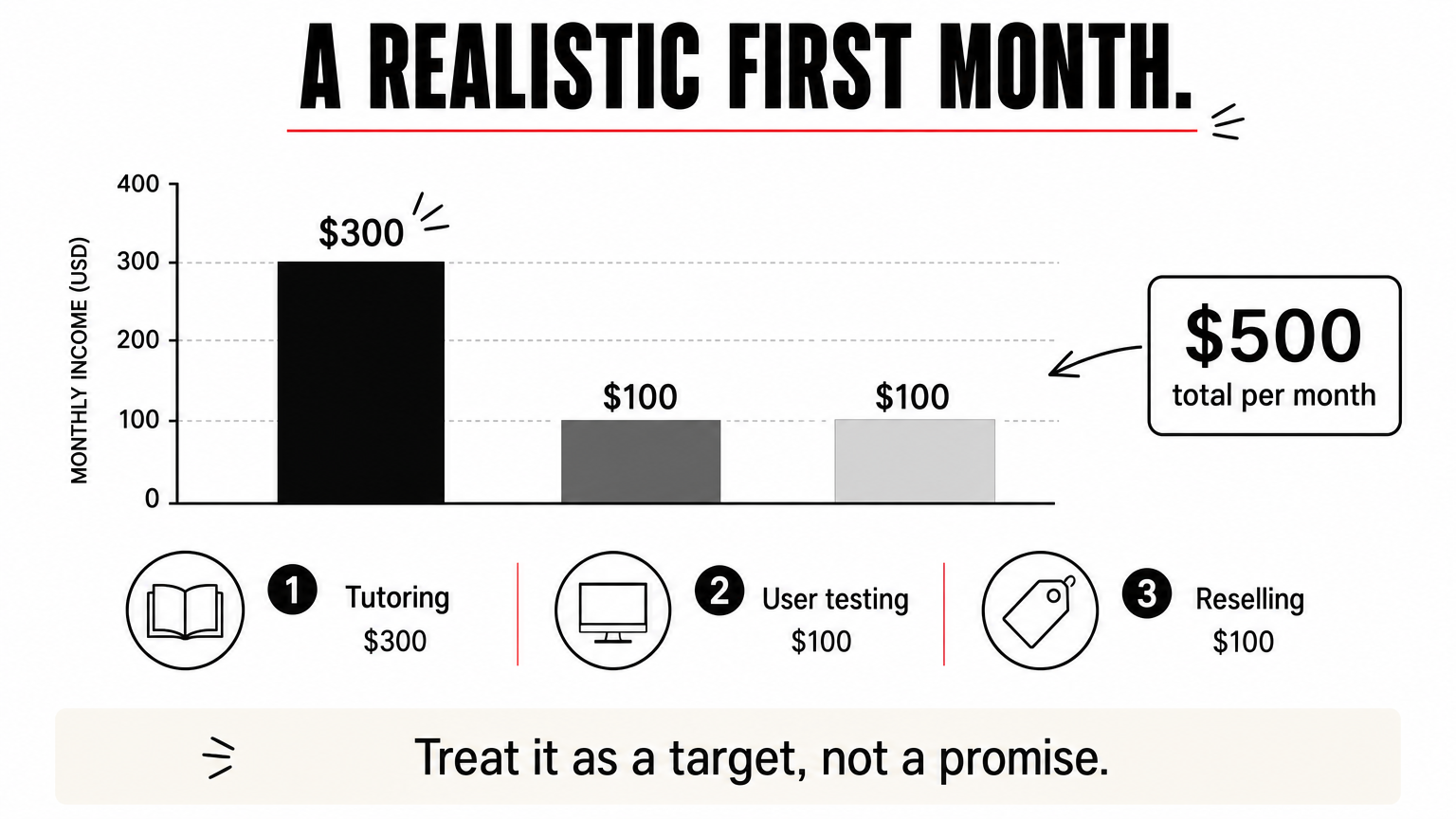
- Tutoring: 3 hours a week at $25 for 4 weeks, which is $300.
- User testing: 10 tests at $10, which is $100.
- Reselling: 5 unused items at $20 each, which is $100.
That totals $500. Treat it as a target, not a promise.
Plan on $100 to $500 a month at first, and build up by moving toward skill-based work.
How to start and avoid online scams
You can start earning with a clear first-week plan, and you can avoid scams by one rule: legitimate platforms pay you, and scams charge you first.
A first-week plan
Follow these steps to get from zero to your first paid task:
- Choose one method from the list that matches a skill or an asset you have today.
- Set up a dedicated email address and, if the platform pays through it, a PayPal account.
- Read the platform's rules on age, country and ID checks before you sign up.
- Finish your profile or qualification test, and complete your first task or pitch by day five.
- Track your time and pay, so you can work out your real hourly rate.
Withdraw your earnings once you reach the payout minimum. Online earning sites are not banks, so do not leave balances sitting on them.
Red flags that signal a scam
Walk away if you see any of these:
- Upfront fees for training, software, a starter kit or a certification.
- Requests for bank details before you have earned anything.
- Promises of hundreds of dollars a day for little or no work.
- Vague job descriptions such as "work from home, no experience needed" with no named role.
- Pressure tactics such as "only 3 spots left" or "apply in the next hour".
- Income that depends on recruiting others instead of selling a real product or service.
If you meet a scam, report it to the Federal Trade Commission at reportfraud.ftc.gov.
Taxes on online income
Online income is taxable in the United States even when no form arrives. If your net self-employment earnings reach $400 or more in a year, you generally need to file a return and pay self-employment tax. Platforms like UserTesting do not withhold tax, so set aside part of each payment. Check IRS guidance or ask a tax professional about your situation.
Start small, never pay to get paid, and keep track of every dollar you earn.
Start with one method
You now have 10 legitimate ways to earn money online, from freelancing and tutoring to surveys and reselling. The pattern is simple. Skill-based work pays the most, task-based work starts the fastest, and content takes the longest. Pick the one that fits what you already know or own, and give it a few weeks before you judge it.
Expect $100 to $500 a month at first, and treat anything that promises more with suspicion. Never pay to get paid, keep a dedicated email for your sign-ups, and set tax money aside from the start.
If you want more step-by-step help, you can read more beginner earning guides on Trick and Tech and pick your first method today.


