
No Experience Jobs Work from Home: 7 Roles to Apply For
The most realistic no experience jobs work from home are customer service, data entry, and virtual assistant work. Customer service and data entry are the easiest to land because employers train new h...

The most realistic no experience jobs work from home are customer service, data entry, and virtual assistant work. Customer service and data entry are the easiest to land because employers train new hires on the job. Virtual assistant, social media, and tutoring roles suit you if you already have everyday skills like organizing, posting, or explaining a school subject. Transcription and software testing fit careful, detail-minded people who like working alone.
Most lists of remote jobs bury you in 25 or 50 titles and leave you to guess which ones will actually hire a beginner. Many listings also say "no experience" and then ask for two years of it. You end up applying blindly, or worse, answering an ad that exists only to collect your money.
This guide narrows the field to seven roles. We picked them because employers routinely train newcomers, you need little more than a laptop and a stable internet connection, and the pay is real. Each role covers what you do, what you need, and what it pays. A final section helps you choose between them, apply, and spot scams. Trick and Tech writes beginner guides for people who want to earn online, so every pay figure below is a rounded public number. Check live listings for what employers offer today.
1. Customer service representative
Customer service is the easiest no-experience remote job to land, and it is the default answer to "what is the easiest work from home job to get?" Companies hire in volume, and most provide training before you handle live customers.

What the job involves
You answer questions from customers by phone, live chat, or email. Most of what you handle is repeat problems that a script or help article already covers.
- Answer order, billing, and account questions
- Follow a knowledge base to solve common issues
- Log each conversation in a ticketing system
What you need to start
A quiet room, a reliable connection, and a headset matter more than a degree. Employers look for clear communication and patience under pressure, because some customers arrive upset.
Chat roles reward typing speed and tidy writing. Phone roles reward a calm voice. Many employers supply a company laptop, but some expect you to own a working computer.
Pay and where to look
Customer service representatives earn a median of about $19 an hour, based on U.S. Bureau of Labor Statistics figures. Pay at your first job will depend on the employer and on whether the role is phone, chat, or email.
Banks, retailers, telecom firms, and airlines post remote support roles on their own career pages. Amazon lists virtual customer service positions on amazon.jobs, and eligibility depends on where you live. Those are real jobs with applications and interviews, not pay-per-click work. Search for "remote customer service" with "entry level" or "training provided."
Customer service is the easiest remote job to land because employers hire in volume and train you themselves.
2. Data entry clerk
Data entry clerks move information from one place into another, and the work rewards accuracy more than speed. It is a good first job if you like quiet, repeatable tasks.
What the job involves
You type information from forms, invoices, or scanned documents into a company system. You also check for mistakes before anything is saved.
- Enter records into databases or spreadsheets
- Compare entries against source documents
- Fix duplicates and formatting errors
What you need to start
Accurate typing and basic spreadsheet skills in Excel or Google Sheets cover most requirements. Employers often run a short typing or accuracy test as part of the application.
Healthcare, banking, and insurance companies hire clerks most often. These employers care about privacy, so expect to sign a confidentiality agreement.
Pay and where to look
Data entry keyers earn a median of about $16 an hour, which is lower than customer service. AI tools now automate the simplest entry work, so treat this job as a stepping stone and build spreadsheet skills as you go.
Look at the career pages of hospitals, insurers, and banks, and search general job boards for "remote data entry." Never pay a "registration fee" to get entry work. Real employers pay you, not the other way around.
Data entry pays modestly, so use it to learn spreadsheets and move up within a year.
3. Virtual assistant
A virtual assistant handles administrative work for a business owner or manager from a distance. This is the best role here if you want to work for yourself over time.
What the job involves
You take routine tasks off someone else's plate. Small business owners and busy executives are the usual clients.
- Manage an inbox and calendar
- Book travel and appointments
- Format documents and do simple online research
What you need to start
You need organization, clear writing, and comfort with tools like Google Workspace, Microsoft Office, and a scheduling app. A formal background is optional.
Without work history, offer a trial week to a local business owner or someone in your network. A few real clients give you more credibility than any certificate.
Pay and where to look
In-office administrative assistants earn a median of about $21 an hour, and that is a fair ceiling to aim for. Freelance beginners usually charge less until they have repeat clients, so set a modest starting rate and raise it with each new client.
Find work through virtual assistant agencies, freelance marketplaces, and word of mouth. Many assistants end up with several clients, which can grow into a small business.
A virtual assistant job is the one beginner role that can turn into your own business.
4. Social media assistant
Social media assistants keep a brand's accounts active. If you already post, comment, and follow trends, you have the habits this job needs.
What the job involves
You support a social media manager or work directly for a small business. The work is steady and creative, and a lot of it is scheduled in advance.
- Schedule posts with a planning tool
- Reply to comments and messages
- Design simple graphics in Canva
- Report on likes, reach, and followers
What you need to start
A short portfolio matters more than a resume. Run an account for 30 days on a topic you like, such as a local food spot or a hobby. Then show the growth and the posts you made.
You also need a feel for the platforms, basic Canva skills, and clean writing. Knowing how Instagram, Facebook, TikTok, and LinkedIn differ helps you stand out.
Pay and where to look
Pay averages around $19.50 an hour, according to Indeed. Agencies often start assistants lower, while freelance rates depend on how many accounts you handle.
Small local businesses are the most open to beginners, since they often have no one handling social media at all. Marketing agencies post assistant roles on their own career pages and on LinkedIn.
A 30-day test account will do more for your application than a blank resume.
5. Online tutor
Tutoring pays for what you know, not for a job history. If you are strong in one subject, you can start teaching it online.
What the job involves
You teach students one on one over video. Sessions usually cover a single subject, from school math to English conversation.
- Explain concepts and work through problems
- Help with homework and exam preparation
- Track the student's progress between sessions
What you need to start
You need real knowledge of a subject and the patience to explain it more than once. Tutors do not need a teaching license, though many online platforms test you in your subject and may ask for a degree or proof of schooling.
A webcam, a headset, and a digital whiteboard tool are enough to start. A short intro video that shows your teaching style helps on most platforms.
Pay and where to look
Tutors earn a median of about $20 an hour, and rates climb quickly for test prep and advanced subjects. Platform tutors often pay the site a commission, so compare the take-home rate, not the listed one.
You can apply to tutoring platforms, or you can find students yourself through friends, schools, and local groups. Your own students usually pay better because there is no middleman.
Tutoring pays for what you already know, so pick the subject where you could explain the most.
6. Transcriptionist
Transcriptionists turn recorded speech into written text. The job suits fast, careful typists who prefer working alone.

What the job involves
You listen to audio from interviews, meetings, podcasts, or videos and type what is said. Captioning work adds timing so the text matches the video.
- Type spoken words accurately
- Label speakers and fix unclear passages
- Proofread before delivering the file
What you need to start
Typing speed and good listening are the core skills. Good headphones help, and many people use a foot pedal or transcription software to control playback.
Each company has a style guide, so expect to take a short test and follow its rules on punctuation and speaker labels.
Pay and where to look
Salary sites list roughly $20 an hour, but transcription is often paid per audio minute or hour of audio. A beginner can spend several hours of work on one hour of audio, so the effective hourly rate is lower. Speech-to-text AI has also cut the simplest jobs. Demand is stronger for people who edit and correct machine drafts.
Apply directly to transcription and captioning companies, and check freelance marketplaces. Start with short files to build speed before taking longer ones.
In transcription, the pay is per audio minute, so your real hourly rate depends on how fast you type.
7. Software QA tester
QA testers use apps and websites before release and report what breaks. You need no coding background, which makes this the most tech-flavored beginner role on the list.
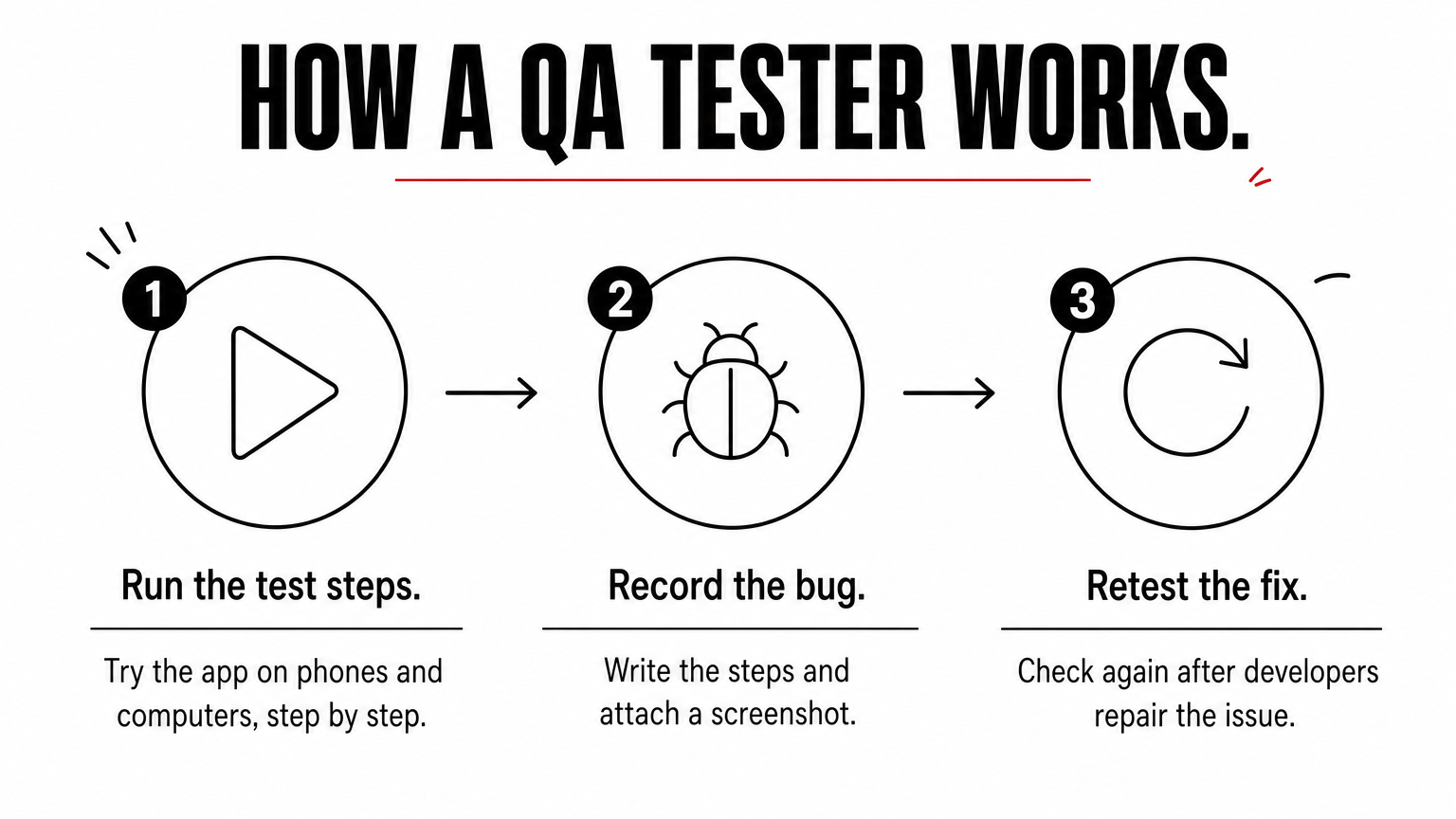
What the job involves
You follow a test script, try to break things, and write up what happened. Clear reports are the whole job, because developers need to reproduce each bug.
- Run through test steps on phones and computers
- Record the bug with steps and a screenshot
- Retest after developers fix the issue
What you need to start
Attention to detail and clear written reports matter most. Learn the basics of a bug tracker such as Jira, and read a free introductory course on software testing so you know the vocabulary.
A modern phone and laptop let you test on more than one device. If you can compare how an app behaves on Android and on a computer, you are already useful.
Pay and where to look
One Payscale-based average for entry-level remote QA roles sits near $68,000 a year, but beginners should expect less while they prove themselves. Contract and per-project testing is common, so ask how you are paid before accepting.
Usability testing sites pay small flat fees per test, so they work as side income. Full QA jobs come through company career pages and software staffing firms.
QA testing pays well for a no-experience job, but you earn it with clear bug reports, not with technical skills.
How to choose, apply, and avoid scams
Pick the role that matches a skill you already use daily, then apply to several openings at once. The steps below also cover how to tell a real listing from a trap.
Which role fits you
The table sets the seven roles side by side. Pay figures are rounded medians or listed averages, so use them for comparison, not as a promise.
| Role | Best for | Pay signal | Main tool |
|---|---|---|---|
| Customer service | Patient communicators | About $19/hour | Headset, ticketing software |
| Data entry | Careful typists | About $16/hour | Spreadsheets |
| Virtual assistant | Organized planners | About $21/hour (admin median) | Email, calendar |
| Social media assistant | Daily social users | About $19.50/hour | Canva, scheduler |
| Online tutor | Subject strong learners | About $20/hour | Video call, whiteboard |
| Transcriptionist | Fast typists | About $20 listed, often paid per audio | Headphones, editor |
| QA tester | Detail-minded testers | Varies by contract | Bug tracker |
Apply in four steps
Move quickly, because openings change daily. Most "immediate start" ads are either scams or exaggerations, since real hiring usually takes days or weeks.
- Search with phrases like "entry level," "no experience," and "training provided" plus the role name.
- Check that the employer hires where you live. Many companies hire only in certain countries or states, while freelance platforms work from anywhere.
- Write a skills-based resume that lists tasks you have done at school, in volunteering, or at home, such as scheduling, typing, or tutoring a friend.
- Apply to five to ten openings a week and follow up once after a few days.
Spot a job scam
Scams target beginners because beginners are eager and do not know what is normal. The Federal Trade Commission's job scam guidance lists the common patterns. Walk away if a listing does any of these:
- Asks you to pay to apply, train, or "register"
- Sends you a check and asks you to buy equipment or send money back
- Interviews you only through a messaging app
- Asks for your bank details or ID before a written offer
- Promises high pay for very simple tasks
Can you reach $1,000 a week?
Not as a beginner in a standard job. At about $19 an hour for 40 hours, you gross roughly $760 a week. To reach $1,000 in 40 hours you need about $25 an hour.
Getting there takes a specialty, a few repeat clients, or a move into a higher-paying role like QA or experienced virtual assistant work. Anyone who promises $1,000 a week for no experience is selling a course or collecting your data.
Treat any no-experience job that promises more than about $20 an hour as suspect until you have checked the employer.
Pick one role and start applying
The best no-experience remote job is the one that matches a skill you already have. Customer service and data entry hire the most beginners, while virtual assistant, social media, and tutoring work let you build something of your own. Transcription and QA testing reward patience and precision. Whatever you choose, never pay to get hired, and check that the employer hires where you live.
Choose one role from the table, build a small sample of your work, and send your first applications. For more beginner guides on earning online and tech skills that help you do it, explore Trick and Tech.


