
Is Charging Your Phone Overnight Bad for Battery Health? Myths vs Facts
Is leaving your phone charging overnight bad for battery health? Discover how modern lithium-ion batteries work, trickle charging myths, and heat safety tips.

Is Charging Your Phone Overnight Bad for Battery Health? Myths, Science, and Best Habits
For millions of smartphone users, the nightly routine is identical: before turning off the lights, you plug your phone into the charger on your nightstand, go to sleep, and wake up to a satisfying 100% battery icon. Yet, almost everyone has heard the persistent warning: "Never leave your phone plugged in overnight — it ruins the battery!"
For years, many people believed this religiously. But as smartphone engineering has advanced, the reality has become much more nuanced. Leaving your phone plugged in all night is far from the catastrophic disaster old myths suggest, but it isn't entirely harmless either. Here is the real science behind lithium-ion batteries, what actually happens when your phone charges overnight, and how simple habits can preserve your battery life for years.
The Old Myth vs. Modern Battery Science
Much of the anxiety surrounding overnight charging stems from older rechargeable battery technology. Decades ago, consumer electronics ran on Nickel-Cadmium (NiCd) and Nickel-Metal Hydride (NiMH) batteries. These older chemistries suffered from a notorious flaw known as the "memory effect" — if you did not fully discharge them before recharging, they gradually lost their maximum capacity over time.
Modern smartphones, tablets, and laptops exclusively use Lithium-Ion (Li-ion) or Lithium-Polymer (Li-Po) batteries. These modern cells behave entirely differently:
- No Memory Effect: Lithium batteries do not need to be completely drained to 0% or cycled in full charges. Partial charging is completely safe and actually preferred.
- Integrated Battery Management Systems (BMS): Inside every modern phone is a sophisticated hardware chip called the Battery Management System. When your battery reaches 100% capacity, the BMS automatically cuts off incoming charging current. Your phone does not continuously pull electricity all night.
- Trickle Charging: Once your phone is full, it switches to a low-power "trickle charge" state — drawing just enough power to top up the battery whenever it drops marginally to 99%, keeping it topped off by morning.
So, What Is the Real Problem with Overnight Charging?
If modern smartphones are smart enough to prevent overcharging, why do battery experts still caution against leaving your phone plugged in for eight hours straight? The issue comes down to chemical tension and voltage stress.
Lithium-ion cells are happiest and experience the least mechanical and chemical strain when they are around 50% charged. The two extreme states — sitting completely empty at 0% or remaining pegged at 100% — place the highest internal tension on the battery's cathode and anode materials.
When you plug your phone in at 11:00 PM, modern fast chargers fill the battery to 100% within 45 to 90 minutes. For the remaining six or seven hours of the night, the battery remains trapped under constant maximum voltage stress, repeatedly bouncing between 99% and 100%. Doing this for a single night causes zero noticeable harm, but repeating this pattern night after night for one or two years gradually chips away at your battery's maximum chemical retention capacity.
The Real Enemy of Your Battery: Trapped Heat
While high voltage stress causes slow, cumulative degradation, there is an environmental factor that accelerates battery death ten times faster: excessive heat.
When charging, lithium-ion batteries naturally generate warmth. If you place your phone on a mattress, tuck it under a pillow, or leave it inside a thick insulating case while plugged into a high-wattage charger, the heat cannot dissipate. Trapped ambient heat destabilizes the liquid electrolyte inside the battery cells, causing irreversible capacity degradation and, in extreme cases, cell swelling.
Crucial Rule: Never charge your phone on top of a soft bed or under a blanket. Always place your phone on a flat, hard, and well-ventilated surface — such as a wooden desk or nightstand — where airflow can keep temperatures low.
Smart Habits to Protect Your Battery Health
You do not need to wake up in the middle of the night to unplug your charger. By implementing a few straightforward adjustments, you can effortlessly prolong your device's lifespan:
1. Enable Optimized or Adaptive Charging
Both major smartphone operating systems now feature built-in artificial intelligence designed specifically to solve the overnight charging dilemma:
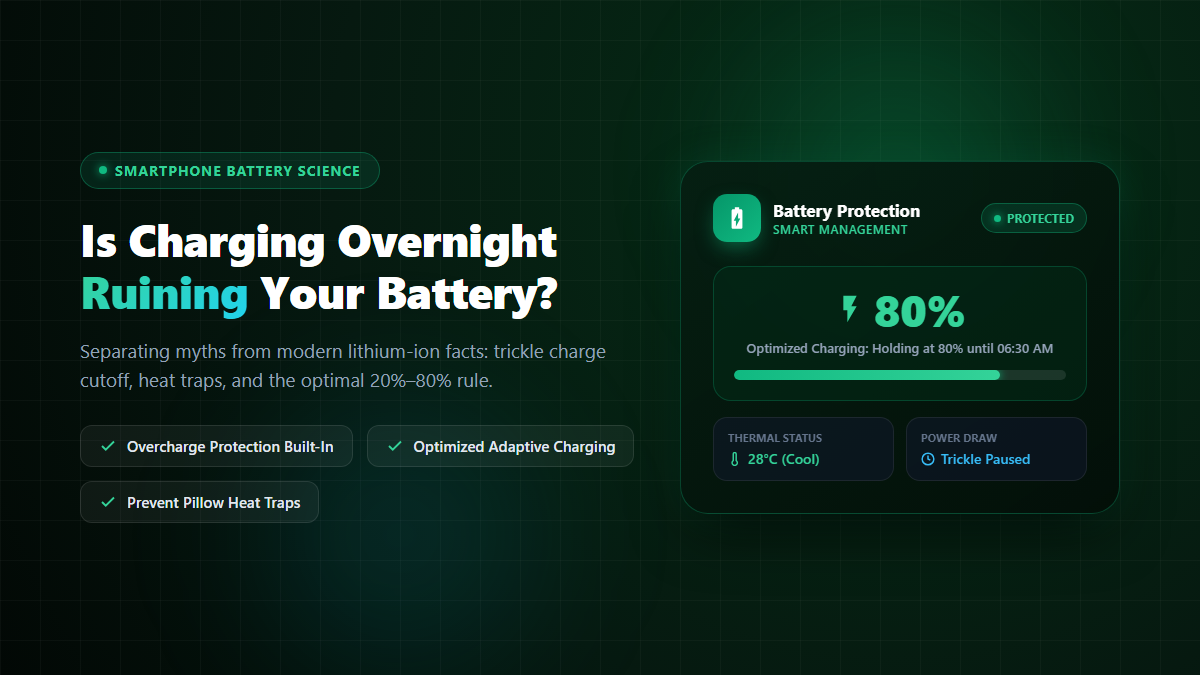
- On iPhone (iOS): Go to Settings → Battery → Battery Health & Charging and turn on Optimized Battery Charging (or set an 80% Limit on newer models). iOS learns your daily routine; it quickly charges to 80%, pauses all night, and finishes the final 20% right before your morning alarm goes off.
- On Android: Depending on your device (Samsung, Google Pixel, Xiaomi), search your settings for Adaptive Charging or Protect Battery. These features restrict charging speeds during sleep hours or cap maximum charging to 80%–85% to eliminate voltage strain entirely.
2. Use a Standard Slow Charger for Overnight Sessions
During the day, 65W, 100W, or 120W ultra-fast chargers are incredibly convenient. However, when you are sleeping for seven or eight hours, you do not need ultra-fast charging speeds. Using a standard 5W or 10W charger overnight keeps thermal output extremely low, protecting both your phone's charging port and its battery chemistry.
3. Practice the 20% – 80% Golden Rule
If you want your smartphone battery to maintain peak health for three to four years without noticeable degradation, aim to keep your battery level between 20% and 80% throughout regular daily use. Recharge before the indicator dips below 20%, and disconnect or cap charging around 80% to 85% whenever convenient.
Quick Summary: Overnight Charging Breakdown
| Aspect | The Myth | The Reality |
|---|---|---|
| Overcharging Danger | Phone continues drawing full current and will explode | Modern BMS chips automatically cut off current at 100% |
| Battery Wear | One overnight charge ruins battery health permanently | Holding 100% for 7 hours causes slow, cumulative chemical stress over 1–2 years |
| Heat Impact | Temperature doesn't matter as long as charger is official | Charging under pillows or in blankets degrades lithium cells drastically |
| Best Night Habit | Drain battery to 0% every night before charging | Enable Adaptive/Optimized Charging and charge on a hard, open surface |
The Bottom Line
To put it simply: leaving your phone plugged in overnight will not blow up your device, nor will it ruin your battery after a few weeks. Modern smartphones possess intelligent safeguards designed to keep you and your device safe.
However, if you want your battery backup to remain strong and dependable for years rather than needing a battery replacement or new phone after 18 months, adopt two simple habits: keep your device cool on an open, flat surface, and turn on your phone's built-in Adaptive Charging features. Taking care of your battery doesn't require obsessive micromanagement — just a little everyday mindfulness.


