
How to Learn Data Science and Machine Learning for Free on Kaggle
Learn Data Science, Python, and Machine Learning on Kaggle Learn for free. Hands-on in-browser coding, zero setup, Google AI tracks, and free certificates.

How to Learn Data Science and Machine Learning for Free on Kaggle: Complete Beginner's Guide
Have you ever wanted to dive into data science, Python programming, or machine learning, but hit a wall after seeing the steep prices of online bootcamps and certification courses? You are certainly not alone. Quality technical education often comes with a hefty price tag, leaving many aspiring analysts and developers wondering if there is an accessible, practical way to break into the field.
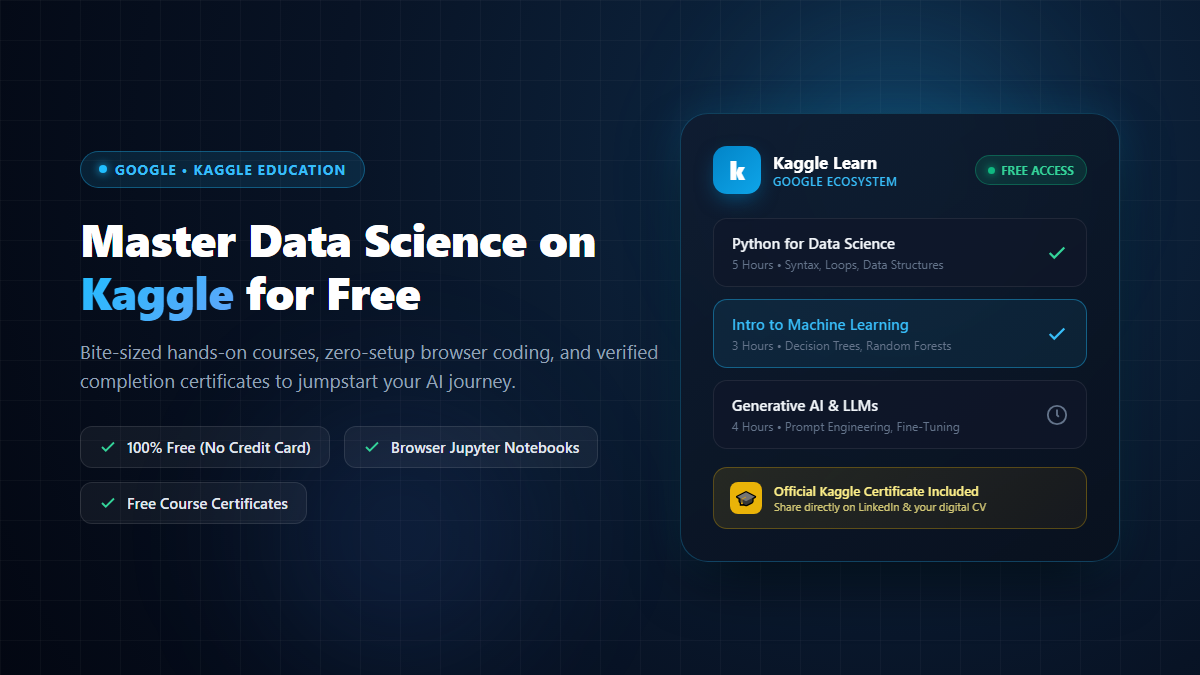
Fortunately, there is an exceptional resource that many beginners overlook: Kaggle Learn. Built by Kaggle — the world's premier data science platform owned by Google — this learning hub offers a comprehensive collection of bite-sized, practical courses that are 100% free, require no credit card, run completely inside your web browser, and grant official certificates of completion upon finishing.
What Exactly Is Kaggle Learn?
To understand Kaggle Learn, it helps to understand Kaggle itself. Kaggle is the world's largest online community for data scientists and machine learning engineers. It is globally renowned for hosting real-world datasets, cloud-hosted Jupyter notebooks, and high-stakes predictive modeling competitions where top teams compete for cash prizes and industry recognition.
While Kaggle's main arena can feel intimidating for beginners, the Learn section was built specifically to bridge that gap. Rather than overwhelming learners with endless video lectures and abstract theory, Kaggle Learn breaks critical skills down into targeted, hands-on micro-courses designed to be completed in hours rather than months.
Kaggle officially provides these courses at zero financial cost, offering an industry-grade learning environment accessible to anyone with an internet connection.
4 Reasons Why Kaggle Learn Stands Out
Compared to traditional online learning platforms, Kaggle Learn takes an entirely distinct pedagogical approach:
- 100% Free with No Paywalls: There are no trials, subscription tiers, or credit card requirements. Every module, dataset, and certificate is genuinely free forever.
- Interactive Micro-Learning Over Long Videos: Instead of sitting through hours of passive video lectures, you read brief, focused explanations and immediately write real code to solidify each concept.
- Zero-Install Browser Coding: You don't need to configure Python, install Anaconda, or debug environment paths on your local computer. Everything runs seamlessly in cloud-hosted Jupyter notebooks inside your browser.
- Profile-Linked Certificates: Every completed course awards a verified digital certificate that is permanently displayed on your public Kaggle profile and can be shared directly to LinkedIn or included on your resume.
Which Course Should You Start With? (The Recommended Roadmap)
If you are opening Kaggle Learn for the first time, the variety of topics might feel broad. Here is the ideal progression path depending on your experience level:
1. Absolute Beginners: Coding Foundations
If you have never written a line of code, or if you need a quick refresher on programming syntax, start here:
- Intro to Programming: Teaches absolute fundamentals — variables, functions, conditions, and basic data types using Python.
- Python: A fast-paced, hands-on sprint covering Python syntax, data structures (lists, dictionaries), loops, and essential libraries needed for data analysis.
2. Data Wrangling & Analysis
Once you understand Python basics, the next essential step is mastering tabular data:
- Pandas: The single most important library in data science. You will learn data indexing, grouping, sorting, filtering, and data transformation techniques.
- Data Visualization: Learn how to create compelling visual narratives using libraries like Seaborn and Matplotlib to uncover hidden trends in raw data.
- Data Cleaning: Practical strategies for handling missing values, standardizing dates, parsing text, and scaling numerical features.
3. Core Machine Learning
With data manipulation under your belt, you can begin training predictive machine learning models:
- Intro to Machine Learning: Build your very first machine learning models using Scikit-Learn. Learn how decision trees and random forests work, and understand model validation metrics like MAE (Mean Absolute Error).
- Intermediate Machine Learning: Level up your modeling toolkit with advanced techniques, including categorical encodings, pipeline construction, cross-validation, and state-of-the-art gradient boosted trees (XGBoost).
- Feature Engineering: Discover how to uncover powerful new signals from raw data using mutual information, clustering, and Principal Component Analysis (PCA).
4. Advanced & Specialized Tracks
For those ready to move into modern AI specializations, Kaggle Learn offers cutting-edge intermediate courses:
- Deep Learning & Computer Vision: Understand artificial neural networks, convolutional neural networks (CNNs), and transfer learning using TensorFlow and Keras.
- Time Series: Master forecasting models for financial trends, inventory demand, and seasonality patterns.
- Natural Language Processing (NLP): Work with text classification, tokenization, sentiment analysis, and transformer architectures.
- Machine Learning Explainability: Learn to explain complex "black box" models using SHAP (SHapley Additive exPlanations) values and permutation importance.
- Intro to AI Ethics: Understand bias, fairness, and accountability in algorithmic decision-making.
- Game AI & Reinforcement Learning: Train agents to make intelligent decisions in interactive game environments.
Overview Comparison: Top Beginner Tracks on Kaggle
| Course Track | Estimated Time | Prerequisites | Key Skills Learned |
|---|---|---|---|
| Python | 4 - 5 Hours | None | Syntax, data structures, booleans, loops |
| Pandas | 4 Hours | Python basics | Data frames, grouping, indexing, summary functions |
| Intro to Machine Learning | 3 Hours | Python & Pandas | Decision trees, Random Forests, model validation |
| Intermediate Machine Learning | 4 Hours | Intro to ML | Missing values, categorical encoders, XGBoost |
| Intro to Deep Learning | 4 Hours | Intro to ML | Dense layers, activation functions, Keras & TensorFlow |
How to Start Learning in 4 Easy Steps
Getting started on Kaggle takes less than two minutes. Follow these practical steps:
- Create a Free Account: Head over to kaggle.com and sign up for a free profile. You can register in one click using your existing Google account.
- Navigate to Kaggle Learn: Click on Learn in the top navigation bar or go directly to kaggle.com/learn. Browse the catalog and select your desired track.
- Read the Tutorial and Code in the Exercise: Each lesson is divided into two parts: an interactive tutorial explaining the concept, and a companion exercise notebook. In the notebook, you write real Python code, test your answers with built-in feedback checkers (
q1.check()), and see immediate results. - Claim and Share Your Certificate: Once all lessons and exercises in a course show 100% completion, your digital Certificate of Completion is automatically generated. You can download it as a high-resolution PDF or share the permanent verification URL directly on LinkedIn.
An Honest Reality Check: What Certificates Can and Cannot Do
While earning certificates feels rewarding, it is essential to maintain realistic expectations about their career impact:
Remember: A Kaggle certificate verifies that you completed a focused introductory curriculum. It is not an accredited university diploma or an automatic ticket to a six-figure data scientist job. Employers value demonstrated ability, problem-solving, and portfolio projects far more than certificates alone.
Here is how to maximize the value of what you learn:
- Use Courses as Springboards: Treat each course as a foundational building block. As soon as you finish a course like Pandas or Machine Learning, find an unfamiliar dataset on Kaggle and build your own independent analysis.
- Publish Clean Notebooks: Document your thought process, share clean visual charts, and publish your notebooks publicly. Getting upvotes and feedback from the Kaggle community builds real credibility.
- English Language Proficiency: All tutorials are presented in straightforward English. If you have moderate reading comprehension, you can comfortably finish most modules in a single afternoon.
Beyond Courses: Intensives, AI Agents, and Competitions
Kaggle Learn is continuously expanding beyond standard micro-courses. Some of its most exciting modern offerings include:
- 5-Day AI & Generative AI Intensives: Developed in close partnership with Google engineers, these workshops cover topics like Prompt Engineering, Gemini API integration, and LLM fine-tuning.
- 5-Day AI Agents Course: Learn how to build autonomous agents that plan, retrieve external data, and execute multi-step workflows.
- Competitions Guide for Beginners: When you feel comfortable writing Python, join classic beginner benchmark competitions like the Titanic: Machine Learning from Disaster or the House Prices: Advanced Regression Techniques. Competing against global participants on a live leaderboard is where practical data intuition is truly forged.
Final Thoughts: Take the First Step Today
The traditional excuse that breaking into artificial intelligence and data science requires thousands of dollars or specialized computer hardware is no longer valid. Kaggle provides state-of-the-art tools, cloud compute power, high-quality instruction, and an enthusiastic global community — completely free of charge.
Visit kaggle.com/learn today, complete lesson one of Python or Machine Learning, and take your first concrete step toward building your own intelligent predictive models.


